

The first images any aspiring Keele student (or one going through Clearing) is hit with when researching Keele is the beautiful red sandstone Victorian mansion nestled between green hills and woodlands. Much of the university’s visual identity is tied to Keele Hall, as well as its promotional material, which shows Keele students enjoying themselves on their adventurous roundtrips around the hall, alongside their conveniently placed picnics situated perfectly in front of the front facade.
So it comes into question why Keele Hall, apart from the occasional balls and formal occasions, plays very little part in student life when, historically speaking, it was the university’s original home.
The original student building
When the first students arrived at Keele in 1950, there was no Chancellor’s or Students’ Union building and no sprawling collection of academic buildings. The centre of the University was Keele Hall.
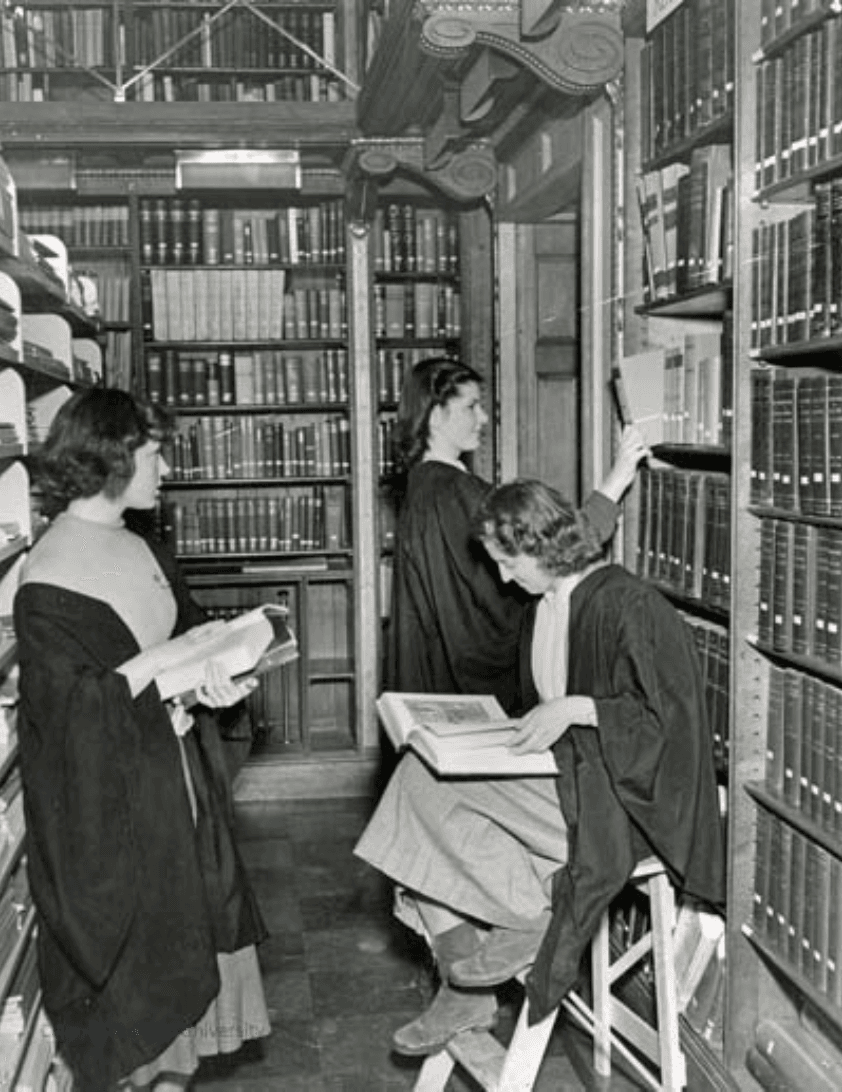
In the 1950s, Keele Hall was the dominant building and a place of study, with the Library and Refectory integrated into it. The Students’ Union occupied three military Nissen huts nearby.
Philosophy, English and History were based in the Hall. The building contained the Library, a reading room, bookshop and Staff Common Room, while tutors occupied smaller rooms.
Student meals would be eaten in the Refectory, with students from the defunct Hawthorns making the journey to the Hall. As the student body grew, the Refectory eventually needed an overflow facility in a wooden RAF hut between Keele Hall and Horwood, later known as Frank Godfer Hall.
Teaching continued in Keele Hall until 2003, when the last departments finally moved elsewhere. Teaching returned in some form in 2016 with the Institute of Liberal Arts and Sciences, but not in the form of a conventional teaching building.
memories made.
Keele Hall was also part of the social and cultural life of the early University.
In 1950, the first students established a drama society, with Henry IV, Part I becoming the first Shakespeare play performed at Keele Hall, in the Hall’s courtyard around 1951–52. The tradition of outdoor Shakespeare has continued for decades.
There were also early student pranks around Keele Hall, including the famous “GOOD LUCK LADS!” painted on the Hall’s courtyard wall before examinations in the 1950s.
And Keele’s mascot, and Concourse’s classic Herbert the Dragon himself, was discovered in three pieces after being buried among rubbish accumulated around the Hall during its wartime occupation. After students and staff repaired it, it subsequently became deeply embedded in student traditions that themselves have since washed away.
So what happened?
Of course, a growing university needs laboratories, lecture theatres, libraries and offices, not a Victorian mansion.
And as the University expanded Keele Hall gradually stopped being the centre of academic life as.
And while the Hall might not be the university centre of administration, I feel the same distance has started to exist between students and their say in the outcomes.
Today, Keele Hall is a major conference, wedding and banqueting facility.
Commercial events generate income for the University, and students themselves use the Hall for balls, conferences, ceremonies and other occasions.
But in an atmosphere where universities are financially struggling and, in my personal opinion, university culture and its traditions are fading, forgetting that a university is first a place for students and teachers before anything else is a mistake.
The University already knows something needs to change
In July, Professor Kevin Shakesheff published a proposal through Keele’s Strategy Journal entitled “Bringing Keele Hall Back to the Heart of the Campus and Student Experience.”
Keele’s Open Strategy Journal is a public forum where the ideas contribute to the development of Keele’s new institutional strategy, due to launch in November 2026.
The proposal argues that Keele Hall should become “a shared space that every student engages with throughout their time at Keele.” It describes the Hall as currently underused, and proposes transforming it into a fully accessible, multipurpose space supporting teaching, student experience, community activity and significant moments in university life.
The proposal suggests four broad changes:
- an accessibility-led refurbishment
- reimagining the use of the existing spaces
- integrating the Hall into the student journey
- a philanthropic fundraising campaign to help pay for the restoration.
While Keele’s strategy journal contains a wide array of ideas there is no confirmation any of them will be carried out.
We could start now
There is no reason the principles of the proposal can’t be put into practice now.
Rather than waiting for a complete redevelopment, Keele could increase the amount of ordinary student activity taking place there now.
Why not establish regular student society evenings in the Hall?
Why not hold public debates, lectures, exhibitions, performances and student conferences there?
Why not have student-run cultural events in the Great Hall?
Why not use some of the quieter rooms for supervised student study or society meetings when they aren’t otherwise booked?
Why not make Keele Hall a regular part of Freshers’ Week and Welcome Week, rather than simply a backdrop in promotional photography?
And why not revive some of the University’s old traditions?
While it may seem like a small thing, a university choosing students over budget and efficiency would be something revolutionary. Especially in this day and age, when redundancies and course closures have been at the forefront of university decisions.
As Professor Shakesheff’s proposal says, Keele Hall should be “a shared space that every student engages with.”
And if the Hall is genuinely at the heart of Keele, as the promotional materials indicate, shouldn’t students be at the heart of the Hall?