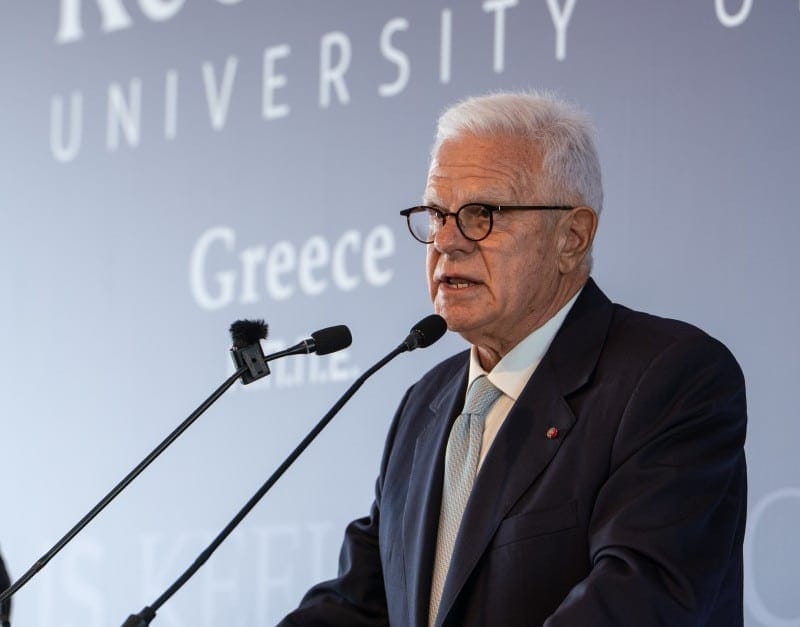



Professor Odysseas Zoras, Vice-Chancellor (Rector) of Keele University Greece, resigned on 12 September 2026.
This comes as Keele’s Greek branch faces a legal dispute over its licence, raising wider questions about the future of Greece’s new non-state university system.
Zoras had publicly criticised the Greek government’s handling of the system, pointing to what he described as “delays and inconsistencies” in its implementation.
“Institutional stability is not a courtesy to investors. It is an obligation of the rule of law.”
This was a criticism of how the government had handled the regulatory framework surrounding non-state universities, particularly the uncertainty created by repeated changes and legal challenges.
Greece’s university system
For decades, Greece’s higher education system was dominated by public universities. That began to change in March 2024, when Prime Minister Kyriakos Mitsotakis’ government passed legislation allowing foreign universities to establish non-state branches in Greece.
The government argued that the reform would give students more choice, attract international universities and investment, and help reduce Greece’s long-running brain drain by giving students the option to study for foreign university degrees without leaving the country.
Critics, however, argued that tuition-charging institutions could create a two-tier system, in which wealthier students had access to additional opportunities while public universities remained under pressure.
The reform triggered weeks of student protests and university occupations. On 8 March 2024, around 17,000 people marched in Athens as Parliament debated the legislation. Clashes broke out between protesters and riot police: police used tear gas and batons, while some protesters threw stones and Molotov cocktails.
Despite the opposition, the new framework went ahead and eventually enabled Keele University to establish its Greek branch, which opened in Athens in 2025.
So what happened to Keele?
The legal dispute centres on how the new universities were licensed and their programmes certified.
The original challenge was brought by Panos Lazaratos, a Professor of Administrative Law at the National and Kapodistrian University of Athens, one of Greece’s public universities.
Lazaratos is critical of the move towards non-state universities, but his legal challenge has mainly focused on a different question: did the government and its regulators follow the law correctly when approving these institutions?
His 2025 challenges ultimately led to the 13 August 2026 Council of State ruling, which annulled the licences of Keele, York and Anatolia because of problems with the licensing and programme-certification process.
Just 15 days later, on 28 August, the Greek government issued Keele a new licence, saying it had repeated the administrative process to comply with the court’s ruling.
But the dispute did not end there.
In September 2026, Lazaratos challenged Keele’s new licence again, arguing that the underlying certification framework remains legally inadequate.
If Lazaratos wins
A successful challenge could mean the new licence is annulled again.
If the framework itself has to be changed, Keele’s programmes could potentially face further reassessment and delays. The exact consequences would depend on what the court rules and how the government responds.
However, the government has already shown that it is determined to keep the non-state university project moving. It re-licensed Keele just 15 days after the original ruling and said it would “take action to ensure students could continue their studies.”
This suggests that, if the new licences face another legal setback, the government may move quickly to correct the problems and keep Keele and the other affected universities operating.
Why does this matter?
Keele Greece is not a small side project.
The Greek branch has announced plans for more than €60 million in investment, including a second Athens campus, 10 new undergraduate and postgraduate programmes, and a proposed Medicine degree.
For Keele, the legal dispute therefore affects much more than its current licence. It could determine how quickly and under what regulatory conditions the university can expand its presence in Greece.